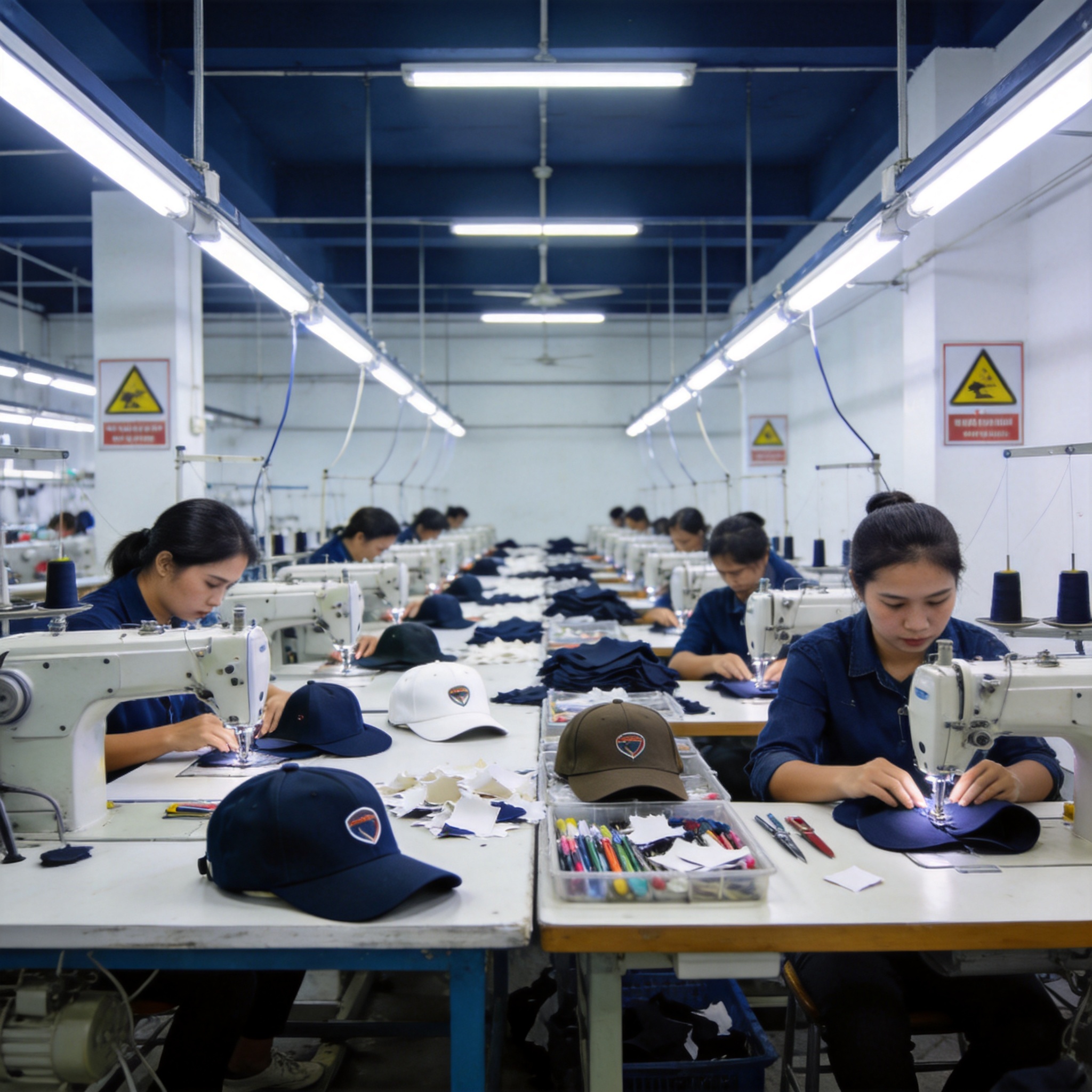
As a timeless classic headwear style, custom caps are favored for versatile looks and excellent brand display effects, widely applied in street fashion, outdoor sports, corporate gifts and team uniforms. A well-designed baseball cap requires not only attractive visuals, but also ergonomic structure, suitable fabrics and high mass production feasibility. Many creative designs end up with collapsed crowns, deformed logos and shrinkage after washing, mainly due to insufficient understanding of cap structures and craft standards. With over 17 years of experience, DEVCOM, a professional Vietnam hat manufacturer, specializes in custom caps OEM/ODM services and has served more than 30,000 global brands. Combining overseas market demands and international craft standards, we share the complete design process of baseball caps from concept to mass production.
1. Silhouette & Structural Design: Classify Styles for Different Markets
The silhouette is the core framework of baseball caps. The six-panel caps are the standard structure for mass production. According to crown firmness and brim radian, there are four mainstream styles for different positioning and regional aesthetics.
Structured caps: Built with inner lining, the crown is round, full and anti-collapse. The front panels are fully symmetrical and side lines are stiff. They are ideal for corporate gifts, high-end streetwear and event souvenirs, and dominate European and American markets. The standard head circumference for adults is 56–58 cm, and crown depth is 12–14 cm, maintaining good shape after long-time wear.
Unstructured caps (dad hats): Without inner lining, the caps are soft and fit closely to heads for a casual lazy look. They are extremely popular in Japanese, Korean and Southeast Asian markets. We usually reduce crown depth and head circumference to make a slim and delicate silhouette for these regions.
Curved bill caps: Traditional classic styles with naturally curved brims. They fit ergonomically, providing sun protection without blocking sight, perfect for daily commuting and outdoor sports with broad audiences.
Flat bill caps: Straight and stiff brims with strong streetwear attributes, popular among young people and fashion brands. Reinforce stitching on brims during design to prevent bending and deformation.
Adjustable closures on the back are also key design elements. Hook-and-loop straps are one-size-fits-all with high cost performance. Plastic snap buckles are durable and retro, the top choice for trendy styles. Full elastic bands are suitable for sports scenarios for better stability. Adjust parameters for different markets: loose oversized silhouettes for Europe and America, slim compact styles for Japan and South Korea, and extra eyelets for tropical and Middle Eastern regions.
2. Fabric Selection Design: Match Scenarios, Seasons & Cross-border Compliance
Fabric determines the touch, stiffness, washing stability and craft compatibility of caps. Designers need to select fabrics based on application scenarios, seasons and export certifications.
Basic fabrics: Cotton twill is soft, breathable and the top choice for daily styles. Pre-shrink treatment is recommended to control shrinkage rate within 3%. Polyester blend (65% cotton + 35% polyester) combines the comfort of cotton and wrinkle resistance of polyester, becoming the main material for bulk foreign trade orders with balanced cost and quality.
Functional fabrics: Quick-drying polyester and mesh fabric are lightweight, breathable, sweat-proof and specially designed for sports caps, ideal for outdoor teams and sports events. Waterproof coated fabrics are suitable for rainy areas.
Stylish fabrics: Corduroy and washed denim create vintage textures for autumn and winter trendy products. GRS recycled fabric (recycled cotton & recycled polyester) has become a necessity for cross-border trade. GRS certified fabrics help products enter European and American supermarkets and cross-border platforms, complying with global sustainable fashion trends.
Design notes: Heavy wool fabrics are not suitable for large-area embroidery to avoid thread pulling. Thin mesh fabric cannot bear large heat transfer prints, as high temperature will damage mesh structure. All export fabrics are suggested to meet OEKO-TEX standards to eliminate hidden dangers of harmful substances.
3. Color Matching: Follow Brand Tone & Control Batch Color Difference
Color is the first visual impression. There are three mainstream color schemes: basic colors, color blocking and tonal matching. Strictly control color consistency during mass production.
Classic colors such as black, navy, khaki and off-white are perfect for corporate gifts and work uniforms. They are versatile and match contrasting logos to enhance brand recognition. Streetwear brands prefer color blocking designs with three colors on crowns, brims and tapes for a trendy look. Minimalist styles adopt tonal gradient colors to create premium texture via fabric textures.
Mark Pantone color numbers for foreign trade customization. Factorial color matching based on color cards can effectively reduce color difference between different batches. Test color fastness for light-colored caps to prevent staining after sweating or washing.
4. Logo & Decoration Design: Standard Sizes to Avoid Deformation
With six-panel structure and relatively flat surface, baseball caps are ideal for logo display. Placement, size and crafts follow mature industrial standards, which are core parts of branded baseball caps design.
Main Logo Placements & Applications
Front center (core position): Highest visibility for main brand logos and corporate marks. Recommended size: width ≤ 11 cm, height ≤ 6 cm. Excessively large patterns will break structural balance; embroidery size is better within 5cm×5cm.
Cap sides: Low-key and luxurious for secondary logos and small icons, size within 2.5cm×1.5cm.
Back closure panel: For brand websites, slogans and years. Do not make it too large to avoid blocking buckles.
Above brims: For mini patterns and small logos, widely used in streetwear designs, not for main logos.
Around top button: Decoration only, not for complex patterns.
Main Craft Matching
Embroidery: Premium option including flat embroidery and 3D puff embroidery. Flat embroidery has delicate lines for business and luxury brands; 3D puff embroidery creates strong 3D effects, popular for streetwear. It is durable and not easy to fall off.
Screen printing: Cost-effective for large patterns, gradient colors and slogans, the first choice for bulk gift caps.
Heat transfer: High color reduction for complex colorful patterns, but less durable, suitable for short-term event caps.
Fabric & leather patches: Retro lightweight decorations sewn on sides or back to increase product added value.
Artwork requirements: Provide AI or EPS vector files. Line thickness ≥ 1mm and font height ≥ 0.6cm to ensure clear printed and embroidered patterns.
5. Accessory & Detail Design: Details Improve Product Grade
High-quality caps stand out with elaborate accessories. Do not ignore details in the design stage.
Vent eyelets: Metal or embroidered eyelets on each panel to improve air permeability; add more eyelets for sports caps.
Inner sweatband: High-elastic sweat-absorbent cotton with thickened design to avoid stuffiness. Custom woven labels are available for high-end styles.
Brim stitching: 8–12 reinforced stitches on curved brims to prevent breakage; increase stitch density for flat bill caps to enhance stiffness.
Top button: Fabric-covered buttons with unified color for better delicacy.
Kids’ caps: Remove sharp metal parts, adopt eco-friendly dyes and reinforce all stitching to meet international children’s safety standards.
6. Prototyping & Mass Production: Realize Design Delivery
After confirming designs, fabrics and crafts, cap prototyping is the final inspection step before mass production to avoid risks.
After receiving your design files, DEVCOM’s designers create 3D renderings within 30 minutes. Physical samples will be finished in 7–10 working days. After receiving samples, check item by item: silhouette symmetry, brim radian, logo position & size, stitching, fabric color and washing stability. Start mass production only after sample confirmation. The standard lead time is 20–35 days. Real-time photos and videos are shared during production for order tracking.
For small-batch creative designs, select from over 2,000 ready-to-ship cap styles to reduce sampling costs and risks. Our factory holds amfori, GRS, OEKO-TEX and other international certifications. All custom hats are inspected in accordance with AQL 2.5 international quality standards, suitable for global markets.
Conclusion
Professional custom caps design is a systematic combination of silhouette, fabric, color, crafts and details. It needs to fit brand styles, target market aesthetics and mass production requirements. As a reliable Vietnam hat manufacturer, DEVCOM provides one-stop OEM/ODM services including creative design, drawing optimization, 3D modeling, sampling and mass production. Whether you need trendy items, sports gear or corporate gift custom caps, we can turn your design concepts into competitive finished products.
Complete Baseball Cap Design Guide: Silhouette, Fabric, Logo Craft & Mass Production
As the most popular style of custom hats, custom caps are widely used for daily wear, sports and brand promotion. Based on rich OEM/ODM experience from DEVCOM, a professional Vietnam hat manufacturer, this article explains the full design specificat…